Thursday, February 28, 2008

The Lion The Witch and the Wardrobe Poem

The story began
On a curious day
When young Peter, Edmund, Susan, and Lucy
Only sought to play
They hid in the wardrobe
Covered in coats
But then stepped behind
And discovered a snowy land
With a huge lamp post
The children stared in amazement
At their new world in awe
No one would ever believe what they saw
A snowy land with no Christmas all year
The white witch cast this spell
And she was to fear
But the siblings would face a tough challenge yet
They must defeat the witch
And all the ev il they met
The children were aided
Along their way, of course
But Aslan, the mighty lion
Had the most force
He guarded the children
With very little strife
He even met with the witch
And sacrificed his own life
However, a fact about Aslan
Must be understood
His magic was not evil
On the contrary; it was very good
With the help of the children
He defeated the queen
And a new land of Narnia
Was to be seen
Young Peter, Edmund, Susan, and Lucy
Now ruled the land
The evil was punished
And the good was never banned
The link below is a clip from the major motion picture The Chronicles of Narnia: The Lion, the Witch and the Wardrobe based on the novel by C.S. Lewis. Take a Look.

Sunday, February 24, 2008

The Lion the Witch and the Wardrobe

Unlike most of my peers in grade school, I never read The Lion, the Witch, and the Wardrobe by C.S. Lewis. So, naturally when I had the opportunity to choose a book that I would journal on, I chose this popular fantasy to make up for my loss as a child. The story has its advantages and disadvantages.
The Lion, the Witch, and the Wardrobe is classified as a heroic or quest fantasy which calls for a story beginning with characters in a primary world who find some passage into a secondary world. When four brothers and sisters named Peter, Edmund, Susan, and Lucy are whisked away from World War II in London and are sent to an old professor's home, they never expect to discover a magical and enchanted wardrobe closet. Depite their sister's confidence in the land of Narnia, Lucy's older siblings do not believe the young child and her journey through the wardrobe into the land of white witches and magical fauns. It is not until all four children decide to hide in the wardrobe closet when visitors are touring the mysterious mansion, that Lucy's saga of the land of Narnia suddenly is transformed into reality before their very eyes. A new challenge faces the four siblings. They now have the obligation of saving Narnia from the wicked white witch and her wishes of ruling the land forever.
As children read this story, they are empowered and motivated when an average set of children with no specific powers or skills of magic are placed in Narnia to defeat the witch. Even though children love nothing more than being placed at the center of these heroic fantasies with an impossible task, they adore defeating the villian of the fantasy with no magic involved. It is much easier for a child to associate themselves with average children withholding no magical powers like the four protagonists in this story. They place themselves in the shoes of young Edmund, Peter, Susan, and Lucy and discover that attributes such as goodness always prevails over evil. C.S Lewis does a magnificent job of incorporating this particular theme in his fantasy.
Even though the tale motivates children, parts of the story line are a bit dark. There are two sections in the story that I found most disturbing. The first occurs when the wicked white witch has captured young Edmund and travels to search for the three other children after the child indicates where his brother and sisters are hidden. Edmund is depicted with his hand tied tightly behind his back being dragged by the dwarf, the queen's assistant. The queen is found calling Edmund a fool and even a brute in this section of the tale. The next section that was extremely gruesome occurs towards the end of the tale when Lucy and Susan find that their hero, Aslan the Lion, is tormented by the witch. The witch jeers at the Lion while her evil assistants which include hags, dwarfs and apes charge at the animal. They proceed to shave his beautiful golden mane, bind his paws together, and muzzle him. Aslan is eventaully killed at the end of this miserable torturing.

Friday, February 22, 2008

Alice in Wonderland (Video vs. Movie)


Although there are a few similarities between the book and the movie, for the most part Lewis Carroll's Alice's Adventures in Wonderland and Walt Disney's Alice in Wonderland have major contrasting elements in plot and characters.Like all of Walt Disney's films, Alice and Wonderland's plot seems to be driven through each musical piece. The musical numbers almost seem to replace the more detailed plot and content in the novel. The complex plot in the novel includes a talking mouse who conducts a caucus race,and a Dutchess with an infant who turns to a baby pig. The movie clearly removes this detailed content and deals more with a broader turn of events topped with this muscial element. However, the film contains the basic elements within Carroll's novel. Throughout the course of the film, the audience observes the unpunctual rabbit, the river of tears, the Chesshire Cat, the Mad Hatter and March Hare, and lastly the infamous Queen of Hearts.
Below is a clip from Walt Disney's Alice in Wonderland that aids in explaining the musical element which is absent from Carroll's novel.

Thursday, February 21, 2008

Alice in Wonderland


In class this week, our discussion has been centered entirely around fantasy stories. The Russel Text adds to our lectures by listing the various types of fantasy stories and naming the hidden rules of the fantasy writers. One such rule states that children demand that their fantasy story not be stolen from them at the conclusion of the tale. Surprisingly, Alice in Wonderland represents a major contradiction of this law that is weighed so heavily with this partiular age sector. Not only is the fantasy aspect of the story instantly removed when Alice realizes that her adventures in Wonderland result from a dream, but Carroll reminds his readers throughout the entire course of the story that Alice is in a deep sleep.
For example, Carroll suggests on the first page of his story that Alice is drifting to sleep. " So she was considering in her own mind (as well as she could for the hot day made her feel very sleepy and stupid.)" Immediately after, Alice envisions a talking rabbit who speeds past her complaining of his unpunctual behavior. What else can be concluded from these opening sentences that Alice is a product of her own dream?
Another way that Carroll seems to scream to his readers that Alice's adventurous journey results from a dream occurs when Alice happens upon the Mad Hatter and the March Hare. When a curious Alice approaches the couple she notices a strange sight that sits between the Hatter and the Hare: a noctural Dormouse who has difficulty staying awake. Is Carroll attempting to relate this sleeping rodent to our protagonist? It is difficult not to wonder whether our author is suggesting that Alice is no different from the mouse: fast asleep and a victim of his own imagination.
Lastly, it is hard not to consider whether Alice's loss of memory is a result of her unconsious state. Alice is constantly found forgetting her most basic knowledge. " Who in the world am I?..... Four times five is twelve....London is the capital Paris."
Little is known of why Lewis Carroll was directly went against the wishes of the children audience. It is interesting, however, to analyze the matter and wonder why the author was so bold in his attempts.

Wednesday, February 20, 2008

Top Ten Children's Literature Through the Years


BBC's Online Network suggests in their online article entitled Education the Books Children are Reading (http://news.bbc.co.uk/1/hi/education/293337.stm) that children's interests and desires have the potential to change significantly over a series of decades.

Top 10 Books for 12-year-olds in 1971


  • Little Women by Louisa M Alcott

  • Black Beauty by Anna Sewell

  • Treasure Island by Robert Louis Stevenson

  • The Lion the Witch and the Wardrobe by C.S. Lewis

  • Jane Eyre by Charlotte Bronte

  • Heidi by Johanna Spyri

  • Oliver Twist by Charles Dickens

  • The Secret Seven by Ian Serraillier

  • Tom Sawyer by Mark Twain


Top 10 books for 12-year-old children in the '90's


  • Point Horror by various authors

  • Sweet Valley series by Francine Pascal

  • Babysitter's Club by Ann M. Martin

  • Matilda by Road Dahl

  • The Witches by Road Dahl

  • The Twits by Road Dahl

  • Charlie and the Chocolate Factory by Road Dahl

  • Adrian Mole by Sue Townsend

  • What Katy Did series Susan Coolidge

Top 10 books for 12-year-old boys in the '90's


  • The BFG by Road Dahl

  • The Witches by Road Dahl

  • Charlie and the Chocolate Factory by Road Dahl

  • Point Horror series by various authors

  • Adrian Mole series by Sue Townsend

  • Asterix series by Rene Goscinny

  • Jurassic Park by Michael Crichton

  • The Twits by Road Dahl

  • The Hobbit by JRR Tolkien


The article states that "children are reading more books than their parents in the 70's" and it also suggests that children are reading nonfictional types of literature like the morning paper. This is thought to be the cause of the modernization of the literature being read which undoubedly calls for the expanding of the child's mind. It can be inferred that these nonfiction reads are driving children to more current literature. Although the stories are fictional, it cannot be argued that stories like The Babysitter's Club series, and Jurassic Park are taken place in the present


Sunday, February 17, 2008

Disney's Enchanted


Disney's Enchanted, is a light-hearted and adorable fim that was released in November of 2008. The movie stands as a representation of how fairy tales are viewed in our society today. The film also answers the question that many adult audiences ask when reading their favorite fairytales: " Could these characters function in our world today?

The film comprises of an all-star cast which includes James Marsden, Julie Andrews (narrarating voice), Susan Sarandon, Patrick Dempsey, and Amy Adams who stars as our princess. The movie features a fairy tale princess and prince who are to be married, but before they can exchange vows the princess is pushed into a well by a wicked witch that carries her to a foreign land that does not guarantee happy endings: New York City. Princess Giselle must learn how to function in this unknown and frightening place until her prince journeys to save her. However, before his arrival she discovers the true meaning of love when she is swept off her feet by a New York City business man.

Princess Giselle and Prince Edward are true representations of stereotypical fairy tale characters. Giselle is kind, generous, sweet, and is a friend to all creatures. Prince Edward is charming, handsome, and is only concerned with the well being of his princess. The two are to be married, but they lack a true love. The couple hardly knows one another, and they are to be married only because of their status in society. However, charming attributes are not enough to help them to function in the real world. Prince Edward jumps over screaching taxi cabs and honking buses to venture to save his "love", and Giselle does not even know the meaning of a date when she arrives in New York City. In reality, the couple is viewed as clueless. Nevertheless, the film is magnificent and is a wonderful film for the family. Below is a video clip of Princess Gisselle effortlessly cleaning house "Snow White Style" with a catchy song and the help from her fellow animal friends. Although the scene is one of my absolute favorites of the entire film, it also helps to point out the far-fetched and unrealistic actions found in most of our fairy tales. Our feminist writers might state that the clip helps to support their general thesis that fairy tale females are known for their domestic abilities.

http://www.youtube.com/watch?v=KObgs81QyR4


Saturday, February 16, 2008

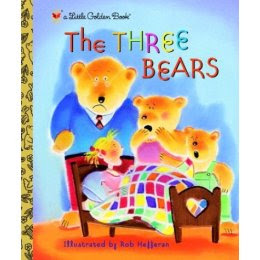
The Three Bears

The Three Little Bears, is a fairy tale that we will not discuss in the classroom this semeter, but it is an adorable tale that could be utilized in Pre-K/Kindergarten classrooms. The story tells of a family of bears:Papa Bear, Mama Bear, and Baby Bear. The family leaves their cozy cottage and journeys in the woods to allow their porridge to cool. When the threesome returns, theyt find that someone has been eating their porridge, lounging in their chairs, and sleeping in their beds. They find at the end of the tale that the culprit is a young girl named Goldilocks .
An inventive method to allow the children to enjoy the tale as well as remember the events chronologically is for the educator to express the fairy tale with a felt board and character cut-outs. The activity would be conducted as follows: The educator would need to purchase a felt board, and apply a cut out of a cozy cottage with three beds, three tables topped with three bowls of porridge, and three chairs. In addition, the instructor would need Papa Bear, Mama Bear, Baby Bear, and Goldilocks cut-outs. Attached to the back of the figures and would be velcro. As the teacher told the story of the Three Little Bears, he/she would stick the velcoro Goldilocks and the three bears cut-outs on the felt board in relation to what the characters are doing in the tale. (For example, if Goldilocks is sitting in the chairs in the bear's home then the instructor would place the Goldilocks cut- out in the chairs on the felt board.) Other fun activities that correspond to this story are found at the website below.